
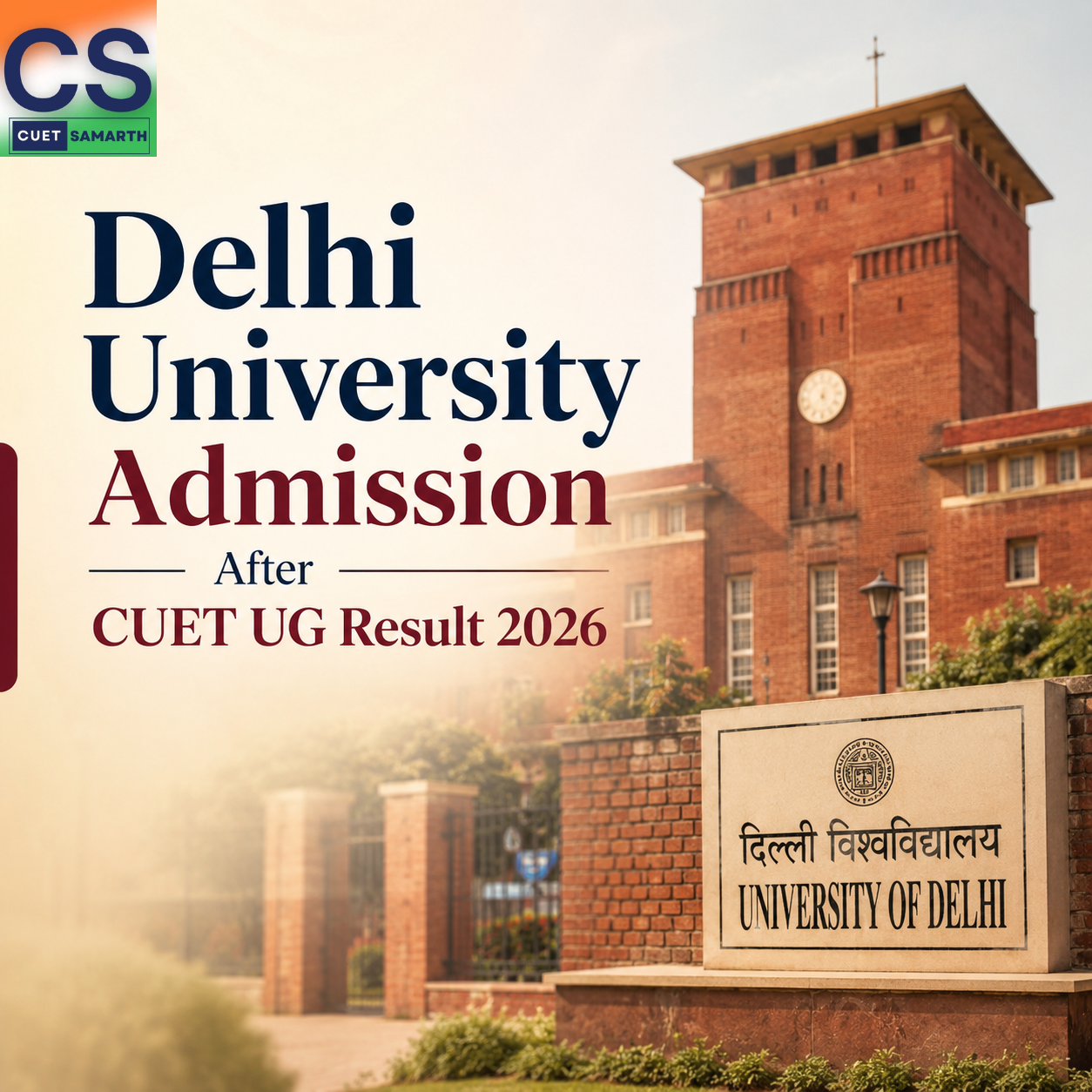
For hundreds of thousands of undergraduate aspirants across India, Delhi University is not merely a destination — it is an aspiration. Home to over 90 affiliated colleges, hundreds of undergraduate programmes, a legacy of academic excellence, and a vibrant campus culture that has shaped generations of leaders, artists, scientists, and professionals, Delhi University (DU) remains the most sought-after CUET UG 2026 admission destination in the country.
With the CUET UG Result 2026 now officially released by the National Testing Agency (NTA), the most time-critical chapter of every DU aspirant’s journey has begun. The period between the result release and the final confirmation of your college seat is filled with registrations, preference filling, seat allotment rounds, fee payments, and document verifications — each governed by strict and unforgiving deadlines.
This comprehensive guide by cuetsamarth.com walks you through every aspect of the Delhi University admission process after CUET UG Result 2026 — from understanding CSAS and filling preferences to navigating seat allotment rounds, meeting document verification requirements, and maximising your chances of securing a seat at your dream DU college. Whether you are targeting SRCC, Miranda House, Lady Shri Ram College, Hindu College, or any of DU’s 90+ affiliated colleges, this guide is your definitive admission roadmap.
Delhi University Admission 2026: An Overview of the Post-CUET Process
Delhi University’s undergraduate admission process has undergone a complete transformation since CUET was introduced as the mandatory admission criterion. Prior to CUET, DU admissions were based entirely on Class 12 board marks, which led to cutoffs routinely touching 100% at top colleges. CUET has standardised the process and introduced a merit-based, subject-score-driven admission system that is arguably fairer — but considerably more complex.
The DU admission process after CUET UG Result 2026 is managed through the Common Seat Allocation System (CSAS) — Delhi University’s centralised online platform for seat allocation across all its affiliated colleges and undergraduate programmes. CSAS is not a standalone registration form; it is a multi-phase, multi-round dynamic system that requires active participation from candidates at every stage.
The Three Pillars of DU CUET 2026 Admission
- CUET UG 2026 Score — the primary and sole merit criterion for DU undergraduate admissions
- CSAS (Common Seat Allocation System) — DU’s centralised platform for programme preference filling and seat allocation
- Document Verification — the final step to confirm and formalise your DU admission
Key Fact: Delhi University does not consider Class 12 marks for undergraduate admissions. Your CUET UG 2026 normalised score is the sole determinant of your DU admission merit ranking.
What is CSAS? Understanding DU’s Common Seat Allocation System 2026
The Common Seat Allocation System (CSAS) is an integrated online portal developed by Delhi University to manage the entire undergraduate admission process — from candidate registration to final seat confirmation. CSAS 2026 operates at admission.uod.ac.in and is the single most important platform you will interact with throughout the DU admission journey after CUET UG Result 2026.
CSAS is designed to ensure transparency, meritocracy, and efficiency in seat allocation across DU’s vast network of colleges and programmes. The system matches candidates to college-programme seats based on their CUET 2026 normalised scores, their ranked programme preferences, availability of seats in each college, and reservation category.
Why CSAS Matters More Than Anything Else in DU Admission 2026
Many candidates underestimate the importance of CSAS and treat it as a simple form-filling exercise. This is a critical mistake. CSAS determines which college and programme you are offered a seat in, and the quality of your CSAS preference list directly determines the quality of your allotment. A candidate with a score of 320/400 who fills preferences carelessly can end up in a less desirable college, while a candidate with 295/400 who fills preferences strategically and completely may secure a far better outcome.
Warning: CSAS is a time-limited, phase-based system. Missing any single phase deadline — registration, preference filling, or allotment response — results in permanent exclusion from DU admission for that academic year. No exceptions are made.
CSAS 2026: Phase-by-Phase Guide to DU Admission After CUET Result
Phase 1 — CSAS Registration
The CSAS 2026 registration window opens within days of the CUET UG 2026 result declaration. This is the first and most urgent task after downloading your scorecard. Registration involves creating your CSAS account, entering your CUET UG 2026 application number and scorecard details, selecting your category (General / OBC-NCL / SC / ST / EWS / PwBD), uploading a recent passport-size photograph, and paying the CSAS registration fee.
Pro Tip: Complete Phase 1 registration within 24 hours of the CUET UG 2026 result release. Registration opens and closes rapidly — treat it as your Day Zero task.
Phase 2 — Programme Preference Filling
Phase 2 is the most consequential step in the entire DU CSAS 2026 process. In this phase, you build and submit your ranked list of programme-college combinations in order of preference. CSAS allows candidates to fill up to 30 or more programme-college preferences — a feature that most candidates significantly underutilise.
Your preference list is the instruction manual you give to the CSAS seat allocation algorithm. The system tries to allocate you the highest-preference combination for which you qualify based on your CUET 2026 merit score, your category, and available seats. Filling more preferences means more allocation opportunities; filling fewer means fewer chances.
How to Build Your CSAS Preference List Strategically
- Research CUET cutoffs from 2024 and 2025 for every college-programme combination on your target list
- Arrange preferences in strict order: most desired combination at Rank 1, safe options toward the bottom
- Include at least 5 dream choices, 10 realistic matches, and 5–8 safe fallback combinations
- Do not leave any preference slot empty — use the full 30+ slots available
- Cross-check subject eligibility for each programme: ensure your CUET 2026 domain papers match requirements
- Include both morning and evening shift options for colleges that offer them — they have separate cutoffs
Critical: Once Phase 2 preference submission closes, you cannot add, remove, or reorder your preferences. Review your list multiple times before the final submission deadline.
Phase 3 — Seat Allotment Rounds and Candidate Response
Phase 3 is where CSAS runs its seat allocation algorithm based on your submitted preferences, CUET 2026 merit, and available seats. DU typically conducts 3 to 5 seat allotment rounds in a single admission cycle. After each round, results are published and candidates must log into CSAS within a narrow response window — typically 48 to 72 hours — to respond to their allotment.
In each allotment round, you have three response options that shape your participation in subsequent rounds:
| Response Option | What It Means | Impact on Future Rounds |
| Accept & Freeze | You accept the allotted college-programme and withdraw from further allotment rounds | Your seat is confirmed; no further upgrades possible |
| Accept & Upgrade | You accept the allotted seat provisionally but remain in consideration for a better match in the next round | If a higher preference opens up in the next round, it replaces current allotment; else current seat holds |
| Reject & Withdraw | You reject the allotted seat and withdraw from all further rounds | You lose all allotments and cannot rejoin CSAS — use only if you do not want DU admission at all |
Strategy: Choose ‘Accept & Upgrade’ in early rounds unless you are completely satisfied with your allotment. This keeps your options open for better colleges while ensuring you do not lose your current seat.
DU CSAS 2026 Important Dates & Deadlines
The following timeline is indicative based on CSAS 2025 patterns. Official 2026 dates will be announced on admission.uod.ac.in and updated on cuetsamarth.com in real-time.
| CSAS Activity | Expected Timeline | Platform | Urgency |
| CUET UG 2026 Result Released | July 2026 | cuet.nta.nic.in | Day Zero — Immediate Action |
| CSAS 2026 Registration Opens | Within days of result | admission.uod.ac.in | CRITICAL — Same day action |
| CSAS Registration Closes | Within 1 week of result | admission.uod.ac.in | CRITICAL |
| Phase 2: Preference Filling Opens | July – August 2026 | admission.uod.ac.in | HIGH — Research in advance |
| Phase 2: Preference Filling Closes | Mid-August 2026 | admission.uod.ac.in | CRITICAL — No extensions |
| Round 1 Seat Allotment Result | Late August 2026 | admission.uod.ac.in | HIGH — Check immediately |
| Round 1 Candidate Response Window | 48–72 hrs post result | admission.uod.ac.in | CRITICAL — Respond same day |
| Round 1 Fee Payment Deadline | 24 hrs after acceptance | Payment Gateway | CRITICAL — Pay immediately |
| Round 2 Allotment & Response | Early September 2026 | admission.uod.ac.in | HIGH |
| Round 3 Allotment & Response | Mid-September 2026 | admission.uod.ac.in | HIGH |
| Round 4 / Spot Round (if applicable) | Late September 2026 | admission.uod.ac.in | MODERATE |
| Online Document Verification | September–October 2026 | College Portals | HIGH |
| Physical Reporting (select colleges) | October 2026 | Respective Colleges | MODERATE |
| Classes Begin | October–November 2026 | College Notice Boards | Plan Accordingly |
DU College-wise CUET 2026 Expected Cutoffs — Programme-by-Programme
Understanding expected cutoffs is essential for building a realistic CSAS preference list. The following cutoffs are indicative estimates based on CUET 2024–25 trends, adjusted for the 2026 result landscape. Note that cutoffs are calculated from CUET normalised scores across 3–4 domain papers combined.
Top DU Colleges — Commerce Stream Cutoffs
| College | Programme | General Cutoff (Approx.) | OBC-NCL Cutoff (Approx.) | SC Cutoff (Approx.) |
| SRCC | B.Com (Hons) | 318–340 | 295–318 | 268–295 |
| SRCC | Economics (Hons) | 315–338 | 292–315 | 265–292 |
| Hindu College | B.Com (Hons) | 295–320 | 272–295 | 248–272 |
| Hansraj College | B.Com (Hons) | 288–312 | 265–288 | 240–265 |
| Shaheed Bhagat Singh C. | B.Com (Hons) | 280–305 | 258–280 | 232–258 |
| Motilal Nehru College | B.Com (Hons) | 270–295 | 248–270 | 222–248 |
| Deshbandhu College | B.Com (Hons) | 260–285 | 238–260 | 212–238 |
| Daulat Ram College | B.Com | 252–278 | 230–252 | 205–230 |
Top DU Colleges — Humanities Stream Cutoffs
| College | Programme | General Cutoff (Approx.) | OBC-NCL Cutoff (Approx.) | SC Cutoff (Approx.) |
| Miranda House | BA (Hons) English | 295–325 | 272–295 | 245–272 |
| Miranda House | BA (Hons) Psychology | 298–328 | 275–298 | 248–275 |
| Lady Shri Ram College | BA (Hons) Political Sc. | 300–330 | 278–300 | 250–278 |
| Lady Shri Ram College | BA (Hons) Economics | 298–326 | 275–298 | 248–275 |
| Ramjas College | BA (Hons) History | 275–305 | 252–275 | 225–252 |
| Ramjas College | BA (Hons) English | 272–300 | 248–272 | 220–248 |
| Kirori Mal College | BA (Hons) Political Sc. | 268–295 | 245–268 | 218–245 |
| Jesus & Mary College | BA (Hons) History | 260–288 | 238–260 | 210–238 |
| Indraprastha College | BA (Hons) English | 250–278 | 228–250 | 200–228 |
| Gargi College | BA (Hons) Political Sc. | 248–275 | 225–248 | 198–225 |
Top DU Colleges — Science Stream Cutoffs
| College | Programme | General Cutoff (Approx.) | OBC-NCL Cutoff (Approx.) | SC Cutoff (Approx.) |
| Hindu College | B.Sc. (Hons) Physics | 285–315 | 262–285 | 235–262 |
| Hindu College | B.Sc. (Hons) Chemistry | 280–308 | 258–280 | 230–258 |
| Hansraj College | B.Sc. (Hons) Mathematics | 278–305 | 255–278 | 228–255 |
| Kirori Mal College | B.Sc. (Hons) Mathematics | 270–298 | 248–270 | 220–248 |
| Deshbandhu College | B.Sc. (Hons) Mathematics | 258–285 | 235–258 | 208–235 |
| Gargi College | B.Sc. Life Sciences | 250–278 | 228–250 | 200–228 |
| Acharya Narendra Dev C. | B.Sc. (Hons) Chemistry | 240–268 | 218–240 | 190–218 |
Disclaimer: Cutoffs above are indicative estimates based on CUET 2024–25 trends. Actual 2026 cutoffs will be published by DU CSAS after seat allotment rounds. Track live cutoff updates at cuetsamarth.com.
Programme Eligibility: Subject Requirements for DU Courses in CUET 2026
Every undergraduate programme at Delhi University specifies the domain subjects that a candidate must have appeared for in CUET UG 2026. These subject requirements are non-negotiable — a mismatch between your CUET 2026 subject combination and a programme’s requirements renders you ineligible for that programme, regardless of your score.
The following table covers the subject requirements for major DU programmes:
| DU Programme | Mandatory CUET Domain Subjects | Additional Subject (if any) |
| B.Com (Hons) | Accountancy + Business Studies + Economics | General Test (GT) |
| Economics (Hons) | Economics + Mathematics or any Social Science | General Test (GT) |
| BA (Hons) Political Sc. | Political Science | Any 2 additional domain subjects + GT |
| BA (Hons) History | History | Any 2 additional domain subjects + GT |
| BA (Hons) English | English (Language paper) | Any 2 domain subjects + GT |
| BA (Hons) Psychology | Psychology (if opted) or relevant Social Sc. | Any 2 domain subjects + GT |
| BA (Hons) Sociology | Sociology | Any 2 domain subjects + GT |
| B.Sc. (Hons) Physics | Physics + Chemistry | Mathematics + GT |
| B.Sc. (Hons) Chemistry | Chemistry + Physics or Mathematics | GT |
| B.Sc. (Hons) Mathematics | Mathematics + Physics | GT |
| B.Sc. (Hons) Statistics | Mathematics + any Science subject | GT |
| B.Sc. (Hons) Computer Sc. | Mathematics + Computer Science (if opted) | GT |
| B.Sc. Life Sciences | Biology/Bioscience + Chemistry | Physics or Mathematics + GT |
| BMS | Business Maths / Maths + any relevant subject | GT |
| BA Programme | Any 3 domain subjects of candidate’s choice | GT optional per college rules |
Always verify the exact subject eligibility criteria for your target programme directly on admission.uod.ac.in before submitting CSAS preferences. Subject requirements can be updated by DU for 2026.
Category-wise Seat Matrix: Understanding DU Reservation in CUET 2026 Admissions
Delhi University follows the Government of India’s reservation policy for undergraduate admissions. Understanding the reservation structure helps you identify the correct cutoff tier for your category and plan your CSAS preferences more accurately.
| Category | Reservation Percentage | Cutoff Differential vs General (Approx.) | Certificate Required |
| General (Unreserved) | No reservation — open competition | Baseline | None |
| OBC-NCL (Non-Creamy Layer) | 27% of seats | 15–25 marks lower than General cutoff | OBC-NCL certificate, current year |
| SC (Scheduled Caste) | 15% of seats | 35–55 marks lower than General cutoff | SC certificate (central government format) |
| ST (Scheduled Tribe) | 7.5% of seats | 40–60 marks lower than General cutoff | ST certificate (central government format) |
| EWS (Economically Weaker Section) | 10% of seats | 15–25 marks lower than General cutoff | EWS certificate, current financial year |
| PwBD (Persons with Benchmark Disability) | 5% horizontal reservation | 25–40 marks lower than General cutoff | Disability certificate from competent authority |
| Kashmiri Migrants / Riot Victims | Supernumerary seats | Separate merit list | Relevant government certificate |
Important Notes
OBC-NCL and EWS certificates must be issued in the current financial year (2025–2026) by a competent government authority. Expired certificates are rejected at verification and can cost you your reserved category seat.
DU Admission 2026: Complete Document Checklist
Document verification is the final gateway to confirming your DU seat. Incomplete or incorrect documents are the most common reason for admission cancellations at the college stage. Prepare every document listed below well before the verification window opens.
| # | Document | Format Required | Notes |
| 1 | CUET UG 2026 Scorecard | PDF + Colour Printout (4 copies) | Download from cuet.nta.nic.in; verify all details |
| 2 | CSAS Allotment Letter | PDF + Printout | Download from admission.uod.ac.in after seat confirmation |
| 3 | Class 10 Mark Sheet | Original + 2 self-attested copies | For age/date of birth verification |
| 4 | Class 10 Passing Certificate | Original + 2 self-attested copies | Board pass certificate |
| 5 | Class 12 Mark Sheet | Original + 3 self-attested copies | Most critical eligibility document |
| 6 | Class 12 Passing Certificate | Original + 2 self-attested copies | Must show passing status |
| 7 | School / College Leaving Certificate | Original | Required for all candidates from all boards |
| 8 | Character Certificate | Original (from last institution) | Issued by Principal/HM within last 6 months |
| 9 | Category Certificate (SC/ST/OBC/EWS) | Original + 2 self-attested copies | Current year for OBC-NCL and EWS |
| 10 | PwBD Certificate (if applicable) | Original + 2 self-attested copies | From competent medical authority |
| 11 | Aadhaar Card | Original + 2 self-attested copies | For identity and address verification |
| 12 | Passport-size Photographs | 8–10 recent colour photographs | Same as uploaded in CSAS profile |
| 13 | Fee Payment Receipt | Printout of online payment confirmation | CSAS portal payment receipt |
| 14 | Migration Certificate | Original (if switching boards/states) | From previous board/institution |
| 15 | Income Certificate (if EWS/fee waiver) | Original, current year | From tehsildar or competent authority |
Tip: Scan and store digital copies of all documents in a single dedicated folder on your phone/cloud before the verification period begins. This makes online document upload instant and error-free.
DU College Profiles: Your Top Targets After CUET UG Result 2026
Shri Ram College of Commerce (SRCC)
SRCC is India’s most prestigious commerce college and consistently records the highest CUET cutoffs among all DU affiliated institutions. Its B.Com (Hons) and Economics (Hons) programmes are fiercely competitive, with General category cutoffs regularly exceeding 315–340 on the CUET composite score. SRCC alumni include top economists, business leaders, chartered accountants, and civil servants. The college has an active placement cell with strong corporate recruiting partnerships. To target SRCC, a CUET composite score of 315 or above across Accountancy, Business Studies, Economics, and General Test is typically necessary.
Miranda House
Ranked consistently as India’s best college by NIRF, Miranda House is a women-only institution affiliated with Delhi University. Its strongest programmes include BA (Hons) English, BA (Hons) Psychology, BA (Hons) History, and BA (Hons) Sociology. Miranda House is known for its exceptional faculty, research environment, and a tradition of producing scholars, civil servants, and media professionals. CUET cutoffs for Miranda House’s top programmes typically range from 295 to 328 for General category candidates.
Lady Shri Ram College (LSR)
Lady Shri Ram College is another all-women DU institution that ranks among the top universities in India. LSR is particularly well-known for its Political Science, Sociology, Economics, and English programmes. The college has an outstanding record of students going on to prestigious postgraduate institutions including JNU, Oxford, Cambridge, and LSE. CUET cutoffs at LSR for popular programmes generally range from 298 to 330 for General category.
Hindu College
Hindu College is one of DU’s oldest and most prestigious co-educational colleges, with strong programmes spanning Commerce, Sciences, and Humanities. The college offers B.Com (Hons), B.Sc. (Hons) Physics, Chemistry, Mathematics, and several BA (Hons) programmes. Hindu College is known for its vibrant student life alongside academic rigour. CUET cutoffs across programmes range from 270 to 320 for General category.
Hansraj College
Hansraj College is a top DU institution with particularly strong Science and Commerce departments. Its B.Sc. (Hons) Mathematics, B.Sc. (Hons) Physics, and B.Com (Hons) programmes are highly competitive. The college is known for producing top academic and professional achievers. CUET cutoffs at Hansraj generally range from 265 to 312 across its competitive programmes.
Ramjas College
Ramjas College has one of the richest academic traditions in DU and is especially well-regarded for its Humanities programmes including BA (Hons) History, BA (Hons) English, and BA (Hons) Philosophy. It is also a strong option for Science students. CUET cutoffs at Ramjas range from approximately 260 to 305 across programmes.
Morning vs Evening Shift Colleges: A Key DU Admission Strategy
Several DU colleges operate both morning and evening shifts for the same programmes. While these are the same institution, morning and evening shifts have separate seat matrices and — importantly — separate CUET cutoffs. Evening shift cutoffs are typically 10 to 25 marks lower than morning shift cutoffs for the same college and programme.
This distinction is a powerful strategic tool for candidates whose scores fall just below the morning shift cutoff of a preferred college. By filling both the morning and evening shift options of the same college as separate preferences in CSAS, you double your chances of securing a seat at your desired institution.
| College | Programme | Morning Shift Cutoff (Approx.) | Evening Shift Cutoff (Approx.) | Difference |
| Hindu College | B.Com (Hons) | 295–320 | 278–302 | ~18–20 marks |
| Hansraj College | B.Sc. (Hons) Maths | 278–305 | 260–288 | ~17–20 marks |
| Kirori Mal College | BA (Hons) Political Sc. | 268–295 | 250–278 | ~17–20 marks |
| Motilal Nehru College | B.Com (Hons) | 270–295 | 252–278 | ~17–18 marks |
| Ramjas College | BA (Hons) History | 275–305 | 258–288 | ~17–20 marks |
Strategy: Always include both morning and evening shift options for every college in your CSAS preference list. This simple step can significantly increase your probability of securing a seat at a preferred institution.
10 Expert Strategies to Maximise Your DU Admission After CUET UG Result 2026
1. Register on CSAS Within 24 Hours of Result
The CSAS registration window is the shortest and most urgent deadline after CUET UG 2026 result release. Treat it as a same-day, non-negotiable task. The registration process itself takes 15–20 minutes, but delays risk missing the window entirely if it closes within days.
2. Research Cutoffs Before Preference Filling Opens
Do not wait for Phase 2 to open before you start researching cutoffs. Begin studying CUET 2024 and 2025 cutoff data for your target programmes right now. Platforms like cuetsamarth.com maintain comprehensive CUET cutoff archives and 2026 cutoff trend analysis to help you prepare a well-researched preference list before the filling window opens.
3. Fill All 30+ Preference Slots in CSAS
The single biggest mistake in CSAS is under-filling preferences. Fill every slot available. A well-researched list of 30 preferences gives you significantly better odds than a careless list of 8. Even your 25th preference might be a college and programme you would genuinely be happy attending — and it might be the one you get allotted.
4. Prioritise Correctly — Dream at Top, Safe at Bottom
Your most desired combination belongs at Rank 1. Your safest combination (one you are virtually certain to qualify for) goes at the bottom. Everything in between should be arranged in genuine order of preference. CSAS will try to give you the highest preference possible — so the more accurately your list reflects your true desires, the better your likely outcome.
5. Use Accept & Upgrade in Every Round Until Satisfied
In every allotment round, choose ‘Accept & Upgrade’ unless you are completely happy with the college and programme allotted. This ensures you never lose your existing seat while remaining eligible for a better one in the next round. Only choose ‘Accept & Freeze’ when you are certain the current allotment is your best possible outcome.
6. Pay Admission Fee Immediately After Acceptance
The fee payment window after seat acceptance is just 24 hours. Failed payments result in automatic seat cancellation with no exceptions. Have your net banking or debit card ready and tested before each round result. Pay within the first hour of accepting to avoid any technical failures close to the deadline.
7. Never Choose ‘Reject & Withdraw’ Unless Certain
The ‘Reject & Withdraw’ option in CSAS removes you from all subsequent rounds permanently. Only use this option if you are certain you do not want any DU seat this year — for example, if you have already secured admission elsewhere. A hasty ‘Reject & Withdraw’ in Round 1 cannot be reversed.
8. Track CSAS Announcements Daily
During the admission season, DU publishes updates — allotment results, schedule changes, technical notices — on admission.uod.ac.in without always sending direct notifications. Check the portal daily and subscribe to cuetsamarth.com alerts for real-time CSAS deadline and allotment updates.
9. Prepare Documents Immediately — Do Not Wait for Allotment
Start gathering all 15 required documents as soon as you download your CUET 2026 scorecard. Category certificates, migration certificates, and income certificates can take days or weeks to procure from government offices. If you wait until the document verification window opens, you may find yourself scrambling for critical documents with insufficient time.
10. Have a Backup Plan Beyond DU
Even with a strong CUET 2026 score, there is no guarantee of admission to your top-choice DU college in highly competitive programmes. Simultaneously register on portals for JNU, BHU, Jamia Millia Islamia, University of Hyderabad, and private universities. Running parallel applications ensures that if DU allotment rounds do not deliver your ideal outcome, you have other strong institutions secured.
Frequently Asked Questions — DU Admission After CUET UG Result 2026
Q1. When does CSAS 2026 registration open after CUET UG Result?
ANS- CSAS 2026 registration on admission.uod.ac.in typically opens within 2 to 5 days of the CUET UG 2026 result declaration. It is essential to complete registration as soon as the portal activates, since the window is typically short — often just 5 to 7 days. Monitor admission.uod.ac.in and cuetsamarth.com for real-time registration date announcements.
Q2. How many programme preferences should I fill in CSAS 2026?
ANS- You should fill the maximum number of preferences allowed by CSAS — typically 30 or more programme-college combinations. Do not self-restrict by filling only your top 5 or 10 choices. A comprehensive preference list dramatically improves your probability of receiving a satisfying allotment, especially if scores for popular programmes are clustered and cutoffs are unpredictable.
Q3. Can I change my CSAS preferences after submission?
ANS- No. Once the Phase 2 preference filling window closes, your submitted preferences are locked. The CSAS system does not allow any additions, deletions, or reordering after the closing deadline. This is why thorough research and careful preference ordering before submission is critical.
Q4. What happens if I miss a CSAS allotment round response deadline?
ANS- Missing a CSAS allotment response deadline results in automatic cancellation of your allotted seat for that round. Depending on your previous response status, you may or may not remain eligible for subsequent rounds. In many cases, missing the Round 1 response without having previously accepted a seat removes you from future rounds entirely. Always set multiple calendar reminders for each round’s response deadline.
Q5. Is my Class 12 percentage considered at any point in DU CSAS 2026?
ANS- No. Delhi University does not use Class 12 board marks for undergraduate admissions under the CUET system. Your CUET UG 2026 normalised score is the sole merit criterion. Class 12 marks are required only for eligibility verification — ensuring you have passed the qualifying examination — not for merit ranking.
Q6. Can I apply to DU and other universities simultaneously?
ANS- Yes, and you absolutely should. Registering on the DU CSAS portal does not prevent you from simultaneously registering on JNU’s, BHU’s, JMI’s, or any other university’s portal. Each university manages its own admission process independently. Applying to multiple universities simultaneously maximises your overall admission security.
Conclusion: From CUET UG Result 2026 to Your DU College — The Journey is Just Beginning
Receiving your CUET UG Result 2026 is a milestone moment — but it is the starting line of the admission race, not the finish. The weeks between result day and the first day of college are among the most consequential of your academic life, and how you navigate the DU CSAS process will directly determine where you spend the next three years.
The good news is that the CUET and CSAS systems, when understood and used strategically, are genuinely merit-based and transparent. A candidate who knows the process — registers promptly, fills preferences comprehensively, responds to allotments wisely, pays fees immediately, and prepares documents in advance — has a dramatically better outcome than one who approaches it casually.
Whether you are targeting the iconic corridors of SRCC, the vibrant campus of Miranda House, the intellectual atmosphere of LSR, or any of DU’s 90+ excellent colleges, your CUET 2026 score combined with smart CSAS strategy is your surest path to success.
At cuetsamarth.com, we are with you at every step — from scorecard download to seat confirmation. Bookmark cuetsamarth.com for live DU CSAS 2026 updates, round-wise allotment results, real-time cutoff tracking, document guidance, and everything you need to make your DU admission journey smooth, informed, and successful.
Your dream DU college is closer than you think. Act fast, plan smart, and trust the process.