
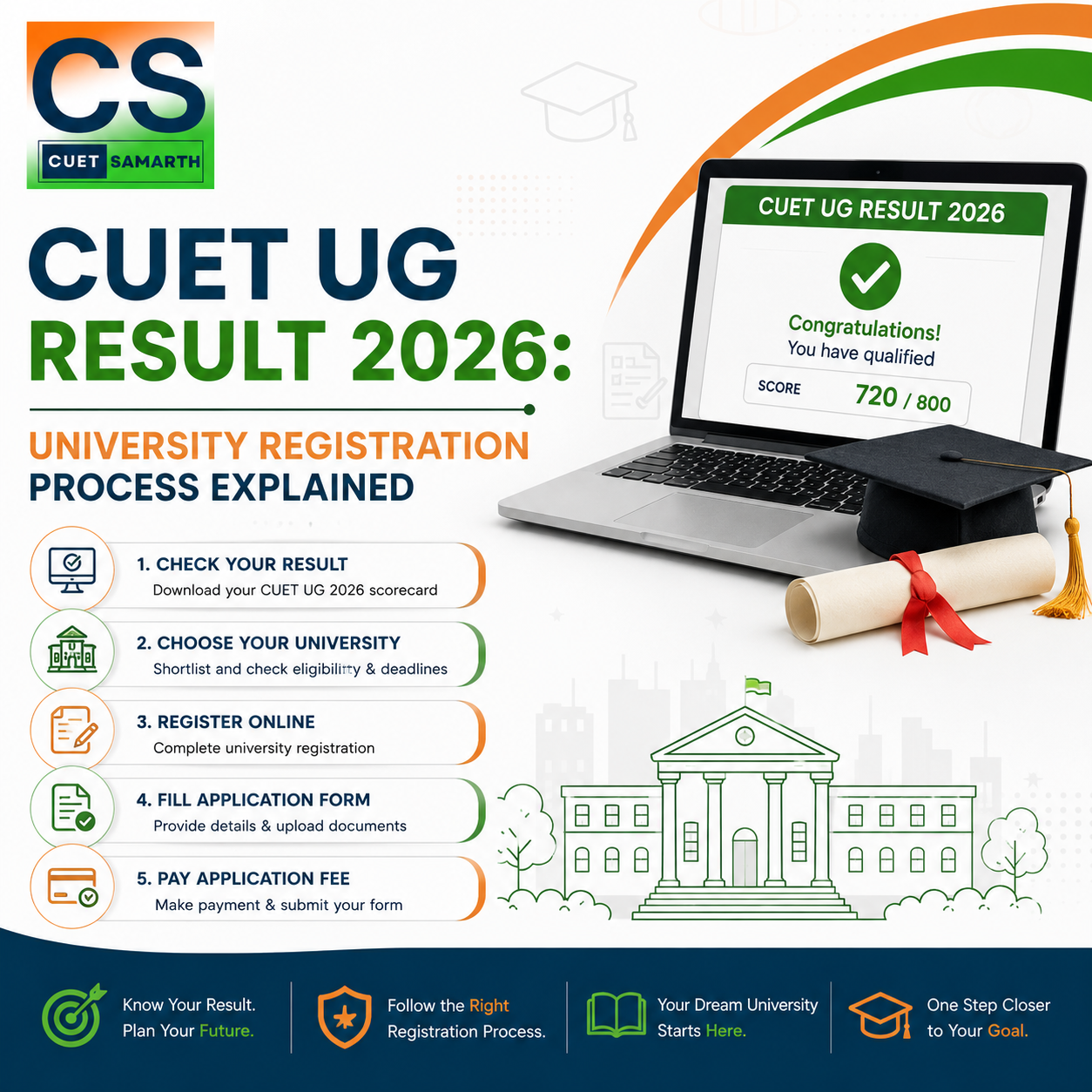
A complete, step-by-step guide to registering at DU, central universities, state universities, and private institutions after CUET UG 2026 result
Introduction: Why the Registration Process Matters as Much as Your Score
The CUET UG 2026 result is the beginning, not the end, of your undergraduate admission journey. For lakhs of students who appeared in the Common University Entrance Test conducted by the National Testing Agency (NTA), the post-result period is when preparation, strategy, and speed of execution determine the actual quality of the college seat secured. A candidate with a 680 normalised score who understands and navigates the university registration process efficiently can secure a better seat than a candidate with 700 marks who misses deadlines, fills too few preferences, or waits for one process to conclude before starting another.
The university registration landscape after CUET UG 2026 is not a single process — it is a parallel set of independent admission systems, each with its own portal, timeline, and documentation requirement. Delhi University uses the centralised Common Seat Allocation System (CSAS). Every central university outside DU runs a separate, independent admission portal with its own application window and counselling schedule. State universities have their own tracks. Private deemed universities accepting CUET scores each have their own registration process.
This comprehensive guide on cuetsamarth.com demystifies every layer of this multi-institutional registration landscape. Whether you are targeting SRCC through DU CSAS, applying to BHU’s Faculty of Arts, seeking admission at Hyderabad Central University or Pondicherry University, or exploring state and private university options as part of a well-rounded application strategy — this article walks you through the process, portal by portal, step by step, with the detail and clarity needed to execute without errors.
Important: The university registration process begins within days of the CUET UG 2026 result and moves fast. Prepare by reading this guide before results are declared — pre-prepared candidates act in hours, not days, and that speed advantage often determines the outcome.
Section 1: Overview of the Post-Result University Registration Landscape
India’s central university system is federated — each institution operates independently, and there is no single unified portal through which a student can apply to all 250+ CUET-participating universities at once. The exception is Delhi University, which has built its own centralised system called CSAS. Everything outside DU requires individual portal registrations.
Understanding this landscape before you begin helps prevent the most common strategic error: treating CUET admissions as a single-portal process and missing the parallel applications that secure safety and target options. The table below provides a quick-reference overview of the key parameters governing university registration after CUET UG 2026.
| Parameter | Details |
|---|---|
| CUET UG 2026 Result Portal | https://exams.nta.ac.in/CUET-UG/ and https://nta.ac.in |
| DU Centralised Portal | DU CSAS — ugadmission.uod.ac.in (opens within 1–2 weeks of result) |
| Non-DU Universities | Each central/state university has its own independent admission portal |
| Login Credentials (NTA) | Application Number + Date of Birth (DD/MM/YYYY) |
| DU CSAS Login | CUET Application Number + CSAS Password (created during registration) |
| Score Used for Admission | Normalised Score per subject (not raw score, not percentile alone) |
| DU Allocation Rounds | Typically 3 rounds (Round 1, Round 2, Round 3) followed by a Spot Round |
| Non-DU Application Mode | Separate online portals for each university — apply simultaneously |
| Key Documents Needed | CUET Scorecard, Class 10 and 12 Certificates, Category Certificate, Aadhaar, Photographs |
| Scorecard Validity | Only for 2026–27 academic year admissions — not valid in subsequent years |
| Helpdesk for Errors | NTA Official Helpdesk (email and phone published post-result on NTA website) |
Strategic note: Prepare your login credentials, scorecard, and documents before result day. The moment results are out, you should be able to begin the DU CSAS registration and non-DU applications within 24 hours — not in the following week after gathering materials.
Section 2: Before Any Registration — Download and Verify Your CUET UG 2026 Scorecard
2.1 Downloading the Scorecard
Every university registration process begins with one document: your CUET UG 2026 scorecard. Go to https://exams.nta.ac.in/CUET-UG/ as soon as NTA announces the result. Log in with your Application Number and Date of Birth in DD/MM/YYYY format, complete the CAPTCHA, and download your scorecard as a PDF. Save it to at least three locations — your device, a cloud service like Google Drive, and as an email attachment to yourself. Print a minimum of six copies on A4 paper immediately.
If the NTA portal is inaccessible due to high traffic in the first hour after results, wait 20 to 30 minutes and try again. Avoid repeatedly refreshing — it worsens server load. Use cuetsamarth.com for the direct working link as soon as it is available. Also check DigiLocker, as NTA progressively integrates scorecard access there.
2.2 Verifying the Scorecard Before Any Registration
Before entering your scores into any university portal, verify every field on your scorecard against your NTA registration confirmation, admit card, Class 10 certificate (for name and date of birth), and category certificate. The fields to check include: your full name spelling, application number, roll number, date of birth, gender, category, state of eligibility, the list of subjects appeared, the raw score for each subject, the normalised score for each subject, and the percentile for each subject.
Any discrepancy — however minor — must be reported to NTA’s official helpdesk before you use the scorecard for applications. A wrong category listed on the scorecard, for example, can lead to ineligibility for reserved-category seats even if you have the correct category certificate. Similarly, a name discrepancy between the scorecard and your Class 12 certificate can cause rejection at document verification.
2.3 Understanding Which Score to Use for Registration
University registration portals ask for your normalised score — not your raw score and not your percentile alone. The normalised score is the figure that appears in the ‘Normalised Marks’ or ‘NTA Score’ column on your scorecard, separate from the raw marks column. This is the statistically adjusted score that accounts for difficulty differences across exam sessions, and it is the metric all universities use for merit list preparation.
A common source of confusion during registration: if your scorecard shows three numbers per subject (raw score, normalised score, percentile), always use the normalised score in university portals. Raw scores are printed for informational transparency but are not the basis of admission decisions. Entering a raw score where a normalised score is required can result in incorrect merit ranking and potential ineligibility for cutoff thresholds.
Critical: Enter your normalised score — not raw marks — in every university registration portal. Double-check the exact figure on your scorecard before typing it into any admission form. A decimal error or digit transposition here can result in a lower merit rank and loss of an otherwise accessible seat.
Section 3: DU CSAS Registration Process — Complete Step-by-Step Guide
Delhi University’s Common Seat Allocation System (CSAS) is the centralised admission portal for all DU affiliated colleges. It is the most sophisticated and complex part of the post-result registration process for students targeting DU. The CSAS process has multiple stages — account creation, score entry, preference filling, allocation rounds, fee payment, and physical reporting — each with its own deadline. The 12-step table below explains every stage in full detail.
| Step | Stage | Full Detail |
|---|---|---|
| 1 | Access CSAS Portal | Visit ugadmission.uod.ac.in after DU announces that CSAS has opened — typically within 1–2 weeks of the CUET UG 2026 result. First-time users must click ‘New Registration’ to create an account. |
| 2 | Create CSAS Account | Register with your CUET UG 2026 Application Number, registered email ID, and registered mobile number. Create and confirm a CSAS-specific password. You will use this password for all future CSAS logins — store it securely. |
| 3 | Verify Identity | The system will auto-fetch your personal details (name, DOB, category, gender) from NTA’s CUET database using your application number. Verify each field carefully. Any discrepancy between your CUET record and your documents must be resolved with NTA before proceeding. |
| 4 | Enter CUET Normalised Scores | Input your normalised score for each CUET subject as shown on your official scorecard. Double-check every entry — incorrect scores submitted here cannot be corrected after the CSAS preference submission deadline. Cross-reference your scorecard carefully before hitting ‘Save’. |
| 5 | Upload Required Documents | Upload clear scanned copies of: CUET 2026 Scorecard, Class 10 Marksheet and Certificate, Class 12 Marksheet and Certificate, Category Certificate (SC/ST/OBC-NCL/EWS/PwD if applicable), Aadhaar Card, and a recent passport-size photograph. Files should be in PDF or JPG format within the size limits specified on the CSAS portal. |
| 6 | Pay CSAS Application Fee | Pay the CSAS application fee online via net banking, debit card, credit card, or UPI. The fee amount and payment gateway will be specified on the portal. Retain the payment confirmation receipt — it is required at physical reporting. |
| 7 | Fill Programme-College Preferences | This is the most important step. Select and rank all eligible programme-college combinations in order of your priority. The CSAS algorithm uses this ranked list to allocate seats — your first preference is considered first. Fill a minimum of 20–25 combinations covering reach, target, and safe options. Do not leave preferences unfilled. CSAS allows unlimited preference entries. |
| 8 | Review and Submit Preferences | Before final submission, review your entire preference list one last time. Ensure the order reflects your genuine priority. Once submitted, preferences cannot be changed after the deadline. Click ‘Final Submit’ only when satisfied. |
| 9 | Check Round 1 Allocation List | DU publishes the Round 1 allocation list on a specified date. Log in to CSAS to view your allocation. You have three choices: Accept and Freeze (confirm this seat permanently), Accept and Upgrade (keep seat but stay in pool for Rounds 2 and 3), or Reject (opt out entirely — risky without a confirmed alternative). |
| 10 | Pay Admission Fee After Acceptance | After accepting any allocation, pay the admission fee within the stipulated window — typically 24 to 48 hours. This deadline is absolute and is not extended. Missing it cancels your seat without any reinstatement option. |
| 11 | Participate in Upgrade Rounds | If you selected Accept and Upgrade, you automatically participate in Rounds 2 and 3. If a better college-programme is allocated, accept and pay fees immediately. If no upgrade arrives, your previous seat remains confirmed. |
| 12 | Physical Reporting at College | After your final seat is confirmed, report to the allotted college within their physical reporting deadline. Carry complete original documents: CUET scorecard, Class 10 and 12 certificates, category certificate, Aadhaar, photographs, and all fee payment receipts. |
Important Notes
Every fee payment deadline in CSAS is absolute. DU does not grant extensions under any circumstances. Candidates who accept an allocation but miss the 24–48 hour payment window have their seat cancelled without reinstatement. Set phone alarms for every CSAS deadline and pay the moment you accept.
3.1 How the CSAS Allocation Algorithm Works
Understanding the CSAS algorithm helps you fill preferences intelligently. The algorithm is merit-based and preference-order-driven: it processes all applicants for each programme-college combination simultaneously, ranking them by their normalised score in the prescribed subjects. For each combination, the algorithm fills seats in rank order until the seats are exhausted or all interested candidates are accommodated.
The algorithm then checks each candidate’s allocation against their preference list. If a candidate is eligible for their first preference, they receive it. If not, the algorithm moves to their second preference, and so on. This is why preference order matters: a candidate who lists a reach college as preference 1 and a target college as preference 2 will receive the target college if the reach college is full and they are rank-eligible for the target.
The critical implication: candidates who fill fewer preferences give the algorithm fewer options to work with. A candidate with 30 preferences has 30 chances to be allocated to something satisfactory. A candidate with 5 preferences has 5 chances. Given that CSAS costs the same regardless of how many preferences you fill, there is no rational reason to fill fewer than 20 to 30.
3.2 The Accept and Upgrade Strategy — When and How to Use It
The ‘Accept and Upgrade’ option in CSAS is one of the most powerful tools available to students in the mid-scoring range. When you receive a Round 1 allocation that is satisfactory but not your top choice, selecting Accept and Upgrade allows you to secure that seat (by paying the admission fee) while remaining in the pool for Round 2 and Round 3 allocations.
If a better college-programme combination becomes available in Round 2 — because higher-scoring students who had been allocated that slot in Round 1 received an upgrade and vacated it — the algorithm may offer it to you. If it does, you receive the upgrade, your Round 1 seat is automatically released, and you pay the Round 2 fee. If no upgrade materialises across Rounds 2 and 3, your Round 1 seat remains your confirmed admission. This option costs nothing extra in terms of process — only the upgraded seat’s fee becomes payable if an upgrade occurs.
The only scenario where Accept and Upgrade is suboptimal is if you are absolutely certain that your Round 1 allocation is your top choice and no upgrade is possible or desired. In that case, Accept and Freeze provides certainty without the uncertainty of waiting through subsequent rounds.
Section 4: Registering at Non-DU Central Universities After CUET 2026 Result
The most important strategic principle for post-result university registration is this: DU CSAS and non-DU university registrations must run in parallel, not sequentially. Many candidates wait for DU CSAS allocation rounds to conclude before turning attention to BHU, HCU, JMI, or other central universities. By that time, the application windows for several non-DU institutions may have closed.
Central universities outside DU run completely independent admission processes. Each has its own portal, its own application window, its own counselling schedule, and its own merit list. These processes do not wait for DU CSAS. In the post-result weeks, a well-organised candidate has applications simultaneously active across five to ten university portals.
| University | Admission Portal (Approx.) | Key Registration Steps & Notes |
|---|---|---|
| Banaras Hindu University (BHU) | bhuonline.in | Register on BHU portal post-result. Enter CUET normalised scores. Apply to all eligible faculties (Arts, Commerce, Science) separately. BHU releases faculty-wise merit lists. Track BHU admission calendar independently. |
| Hyderabad Central University (HCU) | uohyd.ac.in / admission portal | HCU application window is typically short — 2 to 3 weeks. Apply across all eligible programmes simultaneously. Upload CUET scorecard as primary merit document. HCU releases programme-wise cutoff lists post-application. |
| Jamia Millia Islamia (JMI) | jmicoe.in | JMI runs CUET-based admissions for select UG programmes. Register on the JMI COE portal, select programmes, and upload documents. JMI also has internal programmes that run on separate tracks — verify your target programme’s admission mode. |
| Aligarh Muslim University (AMU) | amucontrollerexams.com | AMU accepts CUET for select programmes. Confirm which UG programmes are CUET-based vs internally tested. Register on AMU portal, enter CUET scores, and track AMU’s merit list schedule. |
| Pondicherry University | pondiuni.edu.in / admission portal | Apply on the Pondicherry University admission portal after result. Upload CUET scorecard and academic documents. Given the small seat intake, apply early. The residential campus makes timely physical reporting mandatory. |
| Tezpur University | tezu.ernet.in | Tezpur University admission portal accepts CUET scores for UG science and arts programmes. Register with CUET application number. Tezpur is a strong option for northeast India candidates and those seeking NAAC A-grade central university. |
| CURAJ (Central Univ. Rajasthan) | curaj.ac.in | CURAJ’s admission portal accepts CUET scores directly. Register, upload documents, and apply for B.A./B.Sc. programmes. CURAJ cutoffs are accessible for the 520–580 score range — apply as a strong target option. |
| Central Univ. of Haryana (CUH) | cuh.ac.in | CUH registration follows CUET result. Apply for B.A., B.Sc., and B.Com programmes. CUH has lower competition than major central universities — an excellent target-to-safe option for 500–570 range candidates. |
| Dr. H.S. Gour Univ. (DHSG) | dhsgsu.ac.in | One of India’s oldest central universities. DHSG accepts CUET for UG admissions. Apply through their admission portal with CUET scorecard. Low cutoffs make this a strong safety pick for multiple streams. |
| Central Univ. of Gujarat (CUG) | cug.ac.in | CUG admission portal accepts CUET scores. Apply for B.A. and B.Sc. programmes. Growing infrastructure and modern curriculum. Apply alongside other central universities — takes 30 minutes per portal. |
Strategic note: Create a spreadsheet listing every target university, its portal URL, its application open date (to be filled as portals announce), its application close date, and the status of your application. Update it daily during the post-result period. This simple tool prevents the ‘forgot to apply’ errors that cost students quality seats.
4.1 How Non-DU University Registration Differs from CSAS
Unlike DU CSAS — which is a single login that covers all 60+ DU colleges simultaneously — each non-DU central university requires a separate account, a separate application form, and a separate document upload. You may be submitting the same CUET scorecard and the same category certificate to ten different portals. This is expected and completely permissible — you are not limited to applying to one university.
The practical workload of applying to ten non-DU universities is approximately 15 to 20 minutes per portal for a candidate who has all documents digitally ready. Ten portals represent roughly two to three hours of total effort — an investment that multiplies your admission options by an order of magnitude. Candidates who apply only to DU CSAS are betting their entire educational future on a single system’s outcomes.
4.2 Tracking Counselling Rounds at Non-DU Universities
Unlike DU CSAS where counselling is centralised and announced on a single portal, non-DU universities each run their own counselling. BHU releases faculty-wise merit lists on bhuonline.in. HCU releases programme-wise merit lists on its admission portal. JMI, AMU, Pondicherry, and Tezpur each have their own counselling schedules, and these are not synchronised with each other or with DU CSAS.
Managing this requires creating a personal deadline calendar. For each non-DU university where you have applied: note the expected merit list release date, the document submission deadline for each round, and the fee payment deadline after seat acceptance. Use cuetsamarth.com to track official announcements from each institution — the website aggregates admission updates from all major CUET-participating universities in one place.
Section 5: Documents Required for University Registration — Complete Checklist
Every university registration — whether online or physical — requires a specific set of documents. Preparing your complete document kit within the first week after CUET UG 2026 result declaration means you are ready to submit to any portal or report to any college without scrambling at the last minute. The table below covers every document you need, with the required number of copies and the specific purpose of each.
| Document | Copies Required | Purpose and Notes |
|---|---|---|
| CUET UG 2026 Scorecard (printed PDF) | 4–6 printed copies | Primary merit document for all university registrations and physical reporting. Back up digitally to cloud storage immediately after download. |
| CUET UG 2026 Admit Card | 2 copies | Supporting identity reference during document verification. Retain alongside scorecard throughout admission season. |
| Class 10 Marksheet and Passing Certificate | 2 sets (original + self-attested copy) | Proof of date of birth and name. Must match scorecard details exactly. Used for identity verification at college reporting. |
| Class 12 Marksheet and Passing Certificate | 2 sets (original + self-attested copy) | Primary academic eligibility document. Confirms stream and qualifying examination for the programme applied to. |
| SC / ST / OBC-NCL Certificate | 2 originals | Mandatory for reserved category seat eligibility. Must be issued by competent authority at sub-divisional level or above and must be current/valid. |
| EWS Certificate | 2 originals | Economically Weaker Section certificate issued by the designated authority. Must be from the current financial year as specified by the university. |
| PwD / Disability Certificate | 2 originals | Issued by recognised medical board. Required for PwD category admissions. Some universities require a benchmark disability of 40% or above. |
| Transfer Certificate (TC) | Original + 1 copy | Issued by your Class 12 school. Required by the receiving college at physical reporting time. Obtain from school before admission season begins. |
| Migration Certificate | Original + 1 copy | Required when moving between different state boards or university systems. Not always mandatory — check each university’s specific requirement. |
| Aadhaar Card | 2 self-attested copies | Primary government photo identity document. Required at every stage of online and offline registration. |
| Passport-Size Photographs | 10–12 copies | White background, recent photograph. Required for application forms, college ID card, library registration, and various verification rounds. |
| Fee Payment Receipts | All originals | CSAS application fee, CSAS admission fee, and individual university application fees. Present at every physical reporting round. |
| Gap Year Declaration (if applicable) | 1 self-declaration | Some colleges require a signed self-declaration if there is a gap between Class 12 passing year and the current admission year. |
A common source of last-minute stress at physical reporting is discovering that a document is either unavailable (Transfer Certificate not obtained from school), incorrect (OBC certificate from wrong authority), or expired (EWS certificate from the previous financial year). Resolve all document-related issues in the first week after results — before any admission deadline forces you to act under pressure.
Critical for reserved category candidates: Your SC/ST/OBC-NCL/EWS certificate must be issued by the competent authority designated by the Government of India for central university admissions. A certificate issued by a gram panchayat, village-level officer, or other non-designated authority is not accepted by central universities and can lead to disqualification from reserved category seats.
Section 6: Understanding CSAS Seat Acceptance Options — A Decision Guide
When CSAS releases an allocation, you face a time-sensitive decision with three options. The table below explains each option clearly, including what it means mechanically, and provides guidance on when each is the right choice for a candidate in different situations.
| Option | What It Means | When to Choose |
|---|---|---|
| Accept and Freeze | Confirms your allocated seat permanently. You exit all future rounds. No upgrade is possible after this choice. | Choose this when you are genuinely happy with your Round 1 or Round 2 allocation and do not wish to risk losing it for a marginal upgrade. |
| Accept and Upgrade | Accepts the current seat (paid fee secures it) but keeps you in the pool for Rounds 2 and 3. If a better option arrives, you upgrade automatically. | Choose this in Round 1 if your allocation is satisfactory but not your top preference. This is the most commonly recommended choice — it protects you while keeping the upgrade path open. |
| Reject | Removes you from the current allocation entirely. You forfeit this seat and wait for Rounds 2 or 3 without any guaranteed backup. | Only choose this if you have a confirmed seat at another institution (a non-DU university) that is definitively better. Rejecting without a backup is very high risk. |
| No Action (Deadline Missed) | If you neither accept nor reject within the payment window, the allocation is automatically cancelled. You are still in the pool for subsequent rounds. | Never let this happen. Missing the fee payment deadline is the single most common reason students with good CUET scores lose DU seats. Set reminders and pay immediately upon acceptance. |
The most important thing to understand about CSAS acceptance options is that the fee payment deadline — not the acceptance click — is what ultimately secures your seat. Clicking ‘Accept and Upgrade’ without paying the fee within the stipulated window has the same outcome as clicking ‘No Action’: your seat is cancelled. The system does not treat a clicked acceptance as a confirmed seat until the fee transaction is completed and verified.
Section 7: Registering at State Universities Accepting CUET 2026
A growing number of state universities across India have joined the CUET ecosystem, accepting NTA’s Common University Entrance Test score as a criterion for undergraduate admissions. For candidates who are targeting state-level institutions — whether due to geographic preference, financial considerations, or score positioning — these universities represent a significant expansion of options compared to previous years when state admissions were conducted entirely through separate state-level processes.
State university registration through CUET follows the same basic framework as non-DU central universities: apply on the individual university’s admission portal, submit CUET score details alongside standard academic documents, and participate in the university’s own counselling and merit list process. The key difference is that state universities may also factor in state domicile or Class 12 board marks alongside CUET scores in some cases — always verify the specific admission criteria of each target state university.
| State University | State | CUET Integration & Registration Notes |
|---|---|---|
| University of Allahabad | Uttar Pradesh | Accepts CUET for select UG programmes. Register on UA portal post-result. Strong humanities and science departments. |
| Patna University | Bihar | Uses CUET scores for undergraduate admissions. One of Bihar’s oldest universities. Apply through the PU admission portal. |
| Lucknow University | Uttar Pradesh | Accepts CUET for B.A., B.Sc., B.Com programmes. Register on LU portal. Popular among UP candidates for its central city location. |
| University of Rajasthan | Rajasthan | Accepts CUET for some UG programmes. Register on UoR portal after result. Covers arts, science, and commerce streams. |
| Gujarat University | Gujarat | CUET integration for select programmes. Apply through GU admission portal. Strong in science and commerce. |
| Mahatma Gandhi Central Univ. | Bihar | Central university accepting CUET. Smaller intake; apply early. Good for Bihar-region candidates seeking central univ. degrees. |
| Hemwati Nandan Bahuguna Univ. | Uttarakhand | Accepts CUET scores. Apply on the HNBGU admission portal. Accessible for candidates in the 450–530 score range. |
| Vikram University | Madhya Pradesh | CUET-accepting state university. Apply through VU portal. Strong fallback for MP candidates. |
Note: The state universities listed above have historically accepted or expressed intention to accept CUET scores. Verify each institution’s 2026 admission notification before applying. Some state universities alternate between CUET acceptance and their own entrance processes based on government directives.
Section 8: CUET-Accepting Private Universities — Registration Process
Several private and deemed universities in India have adopted CUET scores as part of their undergraduate admission criteria. While these institutions typically have higher fee structures than central or state universities, they offer certain advantages: flexibility in programme combinations, modern campus infrastructure, strong industry partnerships in specific cities, and in some cases, specialised programmes not widely available in the central university system.
For candidates whose CUET scores are competitive for private university admissions, registering at CUET-accepting private institutions as part of a comprehensive application strategy provides additional options alongside central and state university applications. Private university applications are particularly valuable for candidates in lower score bands (below 550) for whom the central university options are limited.
| Private University | Location | CUET Acceptance Mode & Notes |
|---|---|---|
| Sharda University | Greater Noida, UP | Accepts CUET scores for B.A., B.Sc., B.Com programmes. Apply on Sharda University portal. CUET score considered alongside their own test. |
| Lovely Professional University | Phagwara, Punjab | One of India’s largest private universities. Accepts CUET for UG admissions. Wide programme range. Apply online at LPU portal. |
| Symbiosis International Univ. | Pune, Maharashtra | Accepts CUET for some programmes — verify specific courses. Symbiosis also has SET for management programmes. |
| Amity University | Noida, UP | Accepts CUET scores for certain UG programmes. Strong infrastructure and placement support. Fees higher than central universities. |
| Bennett University | Greater Noida, UP | Accepts CUET for B.A., B.Sc., B.Com, and media programmes. Strong journalism and media faculty. Times Group affiliation. |
| Chandigarh University | Chandigarh | Accepts CUET for select programmes. One of India’s most active placement-network private universities. Apply on CU portal. |
| GD Goenka University | Gurugram, Haryana | CUET-accepting private university. B.A., B.Com, B.Sc. programmes. Good for candidates in the Delhi-NCR region. |
| Manav Rachna University | Faridabad, Haryana | Accepts CUET scores for UG programmes. Strong engineering and management ecosystem. Apply online post-result. |
When applying to private universities through CUET, read each institution’s admission criteria carefully. Some private universities use CUET as a qualifying criterion (you must have appeared in CUET) but then also require their own entrance test or personal interview. Others accept CUET scores directly for merit calculation. This distinction affects how much preparation you need beyond your CUET scorecard for each private university application.
Section 9: Score-Based University Registration Priority Guide
Not all universities are appropriate targets for every CUET score level. Applying to a university whose general category cutoff is 200 marks above your score wastes time and creates false hope. Conversely, applying only to universities well below your score means leaving quality options unexplored. The table below maps CUET score bands to a recommended registration priority sequence — the order in which you should apply across university types based on your score.
| CUET Score | Percentile (Approx.) | University Registration Priority Sequence |
|---|---|---|
| 720 – 800 | 99+ | 1. DU CSAS (target top colleges: SRCC, Miranda House, Hindu) 2. BHU 3. HCU 4. JMI as backups |
| 660 – 719 | 95 – 99 | 1. DU CSAS (mid-top DU colleges) 2. BHU 3. HCU 4. JMI 5. Pondicherry |
| 600 – 659 | 87 – 95 | 1. DU CSAS (mid-tier DU) 2. BHU 3. HCU 4. JMI 5. AMU 6. Pondicherry 7. Tezpur |
| 540 – 599 | 76 – 87 | 1. DU CSAS (lower-mid DU) 2. Pondicherry 3. Tezpur 4. CURAJ 5. CUH 6. CUG 7. DHSG |
| 480 – 539 | 60 – 76 | 1. CURAJ 2. CUH 3. CUG 4. DHSG 5. CUK 6. CUO 7. State universities 8. Private CUET-accepting universities |
| Below 480 | < 60 | 1. State universities accepting CUET 2. Private deemed universities 3. Evaluate gap year for CUET 2027 |
The priority sequence in the table above is a starting framework, not a rigid prescription. Your personal stream, programme preference, geographic priorities, and career goals should all inform how you customise this sequence. A candidate with 620 marks who specifically wants a research career in physics should prioritise Tezpur University and HCU over DU mid-tier commerce colleges, even if the general priority sequence suggests DU first. Match your sequence to your goals, not just your score.
Section 10: Complete University Registration Timeline — CUET UG 2026
The post-result admission season is compressed, fast-moving, and deadline-driven. Every milestone in the table below is time-sensitive. Missing a single deadline can forfeit a seat, close a portal, or eliminate a university from your options permanently. Use this timeline as your master calendar for the 2026 admission season.
| Event / Milestone | Expected Period (2026) | Action Required |
|---|---|---|
| CUET UG 2026 Result Declaration | July 2026 | Download scorecard immediately from NTA portal. Back up to cloud. Verify all fields. Print 4–6 copies. |
| NTA Scorecard on DigiLocker | Within days of result | Link and save scorecard via DigiLocker as an additional verified digital copy. |
| DU CSAS Portal Opens | Within 1–2 weeks of result | Register immediately. Do not delay — CSAS has a limited registration window. |
| CSAS Preference Submission Closes | Approx. 7–10 days after CSAS opens | Submit all preferences before this deadline. Late submissions not accepted. |
| BHU Application Window | July–August 2026 | Apply on bhuonline.in across all eligible faculties as soon as the window opens. |
| HCU Application Window | July–August 2026 | Apply on HCU portal — short 2–3 week window. Do not miss it waiting for CSAS. |
| JMI / AMU Application Windows | July–August 2026 | Apply independently on jmicoe.in and AMU portal within their respective windows. |
| Pondicherry / Tezpur / CURAJ | July–August 2026 | Apply on each university’s portal. Track each one’s deadline separately. |
| DU CSAS Round 1 Allocation | August 2026 | Check allocation. Accept (Freeze or Upgrade) and pay fees within 24–48 hours. |
| DU CSAS Round 2 Allocation | August 2026 | If on Upgrade path, check Round 2. Accept and pay fees immediately if upgraded. |
| DU CSAS Round 3 Allocation | August–Sept 2026 | Final round. Accept and freeze your final DU seat. |
| Non-DU Counselling Rounds | August–Sept 2026 | Attend BHU, HCU, JMI counselling as per their individual schedules. |
| Physical Reporting at College | After each round | Report with full document kit within the college’s stated reporting deadline. |
| Spot Round / Stray Vacancy | September–Oct 2026 | Last-chance round for unfilled seats. Attend in person with documents ready. |
| Academic Session Commences | October–Nov 2026 | First day at your admitted college. Begin orientation and document submission within the institution. |
Important Notes
Dates are indicative projections based on 2023–25 CUET cycle patterns. Official 2026 dates will be confirmed by NTA and individual universities as the result season unfolds. cuetsamarth.com will maintain a live, updated timeline with confirmed dates — bookmark the website and enable notifications to stay ahead of every deadline.
Section 11: Common Registration Errors and How to Avoid Them
University registration errors are common, consequential, and largely preventable. The table below covers the eight most frequently reported registration issues across DU CSAS and non-DU university portals, along with their root causes and solutions.
| Error / Problem | Root Cause | Solution |
|---|---|---|
| CSAS not fetching CUET data automatically | Application number entered incorrectly or NTA data sync delay | Re-enter your 11-digit CUET application number exactly. If the issue persists after 24 hours, contact DU helpdesk with your NTA application number and scorecard. |
| Normalised score entry rejected by CSAS | Score entered exceeds system maximum or has formatting error | Enter scores exactly as printed on your NTA scorecard — no rounding, no estimation. If your scorecard shows 187.26, enter 187.26, not 187 or 188. |
| Document upload failing on CSAS or university portal | File size too large, wrong format, or corrupted file | Compress PDFs to under 500KB using a PDF compressor. Ensure JPGs are under 200KB. Use Chrome or Firefox. Avoid mobile browsers for document uploads. |
| Category certificate not accepted by portal | Certificate is expired, wrong format, or issued by wrong authority | SC/ST certificates must be issued by the sub-divisional magistrate or above. EWS must be from current financial year. OBC-NCL must specify non-creamy layer status explicitly. |
| Wrong normalised score entered in university portal | Confusion between raw score and normalised score on scorecard | Always use the NORMALISED SCORE column on your NTA scorecard, not the raw marks column. These are different figures. Raw scores are not used for merit calculation. |
| CSAS preference list submitted with wrong order | Preferences finalised before thorough review | CSAS typically allows editing preferences until the final submission deadline. Log in and revise your preference order before the deadline closes permanently. |
| Missed non-DU application window | Focused only on CSAS while waiting for DU allocation | Applications to non-DU universities cannot be submitted after their deadline. Contact the university’s admission cell to check if any grace period exists — but prevention is the only reliable solution. |
| Fee payment failed after accepting CSAS seat | Bank server error, internet interruption, or UPI timeout | Try a different payment method (net banking vs UPI vs debit card). If the amount was debited but portal shows failure, wait 24 hours for auto-reconciliation or contact DU’s payment helpdesk immediately with transaction ID. |
Section 12: Physical Reporting at Your Allotted College — What to Expect
After your seat is confirmed through any of the registration systems described in this guide, you must physically report to your allotted college within the college’s stated reporting deadline. Physical reporting is the final step that converts an online allocation into an actual admission. Missing the physical reporting deadline — even by one day — can result in seat cancellation at some institutions.
12.1 What Happens at Physical Reporting
At physical reporting, the college’s admission committee will verify all your original documents against the digital copies submitted during online registration. They will collect one set of attested photocopies of all major documents, issue you a provisional admission letter or student ID card, and direct you to pay any remaining institutional fees (library deposit, sports fee, college development fund, etc.) that were not covered during the online fee payment.
Many colleges conduct this process over two to three days in batches. Arrive on the date specified in your allocation letter with all original documents and multiple copies. Carry extra photographs — you will need them for the college ID card and potentially for several forms you fill out on your first day.
12.2 What to Do If You Cannot Report Within the Deadline
If you face a genuine emergency that prevents you from reporting within the physical deadline — a medical situation, a natural disaster, a family emergency — contact the college’s admission office immediately and in writing (email) before the deadline passes. Most colleges have a provision for granting extensions in genuine emergency circumstances, but only if you communicate proactively. Unexplained absences without prior communication are treated as voluntary seat forfeitures at most institutions.
For candidates who receive allocations at multiple institutions simultaneously (e.g., DU CSAS allocation and a non-DU central university allocation on the same day), prioritise the institution you have decided to join, report there within deadline, and then formally withdraw from the other institution’s waiting process to release your reserved seat for the next eligible candidate. This is an ethical practice that also prevents administrative complications.
Section 13: Critical Mistakes to Avoid During University Registration
- Applying only to DU CSAS and neglecting non-DU portals: The single most common strategic error. Apply to all universities in parallel.
- Filling too few CSAS preferences: Every unfilled preference is a forfeited allocation opportunity. Fill at least 20 to 25 preferences across reach, target, and safe colleges.
- Entering raw scores instead of normalised scores in portals: Normalised scores are the merit metric. Entering raw marks creates incorrect merit rankings.
- Waiting for CSAS Round 1 results before applying to non-DU universities: By the time Round 1 results arrive, several non-DU portals may have closed.
- Missing fee payment deadline after CSAS acceptance: The 24–48 hour window is absolute. Pay immediately upon clicking Accept.
- Uploading expired or incorrect category certificates: OBC-NCL must specify non-creamy layer; EWS must be from the current financial year; all must be from the correct issuing authority.
- Submitting wrong scores due to scorecard confusion: Always cross-reference the normalised score column on the NTA scorecard before typing it into any portal.
- Rejecting a CSAS allocation without a confirmed alternative seat: Only reject if you have a confirmed, fee-paid seat at another institution.
- Not creating a deadline calendar for non-DU universities: Without a personal tracker, portal deadlines slip by unnoticed.
- Delaying document preparation until after allocation: Documents should be ready within the first week after results — not assembled in a rush after a seat is allocated.
- Applying to programmes for which you did not appear in the required CUET subjects: Each university specifies CUET subjects for each programme. Check eligibility before applying.
- Ignoring category-specific cutoffs: Reserved category candidates often have access to a much broader set of colleges than general category cutoffs suggest.
Section 14: Frequently Asked Questions (FAQs)
Q1. What is CSAS and how does it work for university registration after CUET 2026 result?
ANS: CSAS stands for Common Seat Allocation System — Delhi University’s centralised admission portal for all its affiliated colleges. After CUET results are declared, candidates register on CSAS (ugadmission.uod.ac.in), enter their normalised scores, fill ranked programme-college preferences, and receive allocations through multiple rounds. DU uses CSAS as the sole admission gateway — no college-specific applications are required separately within DU.
Q2. Can I apply to both DU and non-DU universities at the same time?
ANS: Yes — and you absolutely must. DU CSAS and all non-DU university portals are entirely independent. Applying to multiple universities simultaneously is not only permitted but essential for a comprehensive admission strategy. There is no conflict between having an active CSAS registration and active applications at BHU, HCU, JMI, and Pondicherry University at the same time.
Q3. What score should I enter in university registration portals — raw score or normalised score?
ANS: Always enter the normalised score (also called NTA Score or Normalised Marks on your scorecard). This is the statistically adjusted figure that accounts for difficulty variations across exam sessions. It is the score universities use for merit list preparation. The raw score column on your scorecard is informational only and should not be entered into admission portals.
Q4. How many CSAS preferences should I fill?
ANS: Fill as many as possible — a minimum of 20 to 25 programme-college combinations is strongly recommended. CSAS allows unlimited preference entries at no extra cost. The more preferences you fill, the higher your probability of receiving a Round 1 allocation at a college you would genuinely attend. Candidates who fill fewer than 10 preferences significantly reduce their chances of a satisfactory first-round allocation.
Q5. What happens if I miss the fee payment deadline after accepting a CSAS allocation?
ANS: If you accept a CSAS allocation but fail to pay the admission fee within the stipulated 24–48 hour window, your seat is automatically cancelled without any reinstatement option. You remain in the pool for subsequent rounds, but your Round 1 seat is permanently lost. This is why immediate fee payment upon acceptance is non-negotiable — pay the moment you click Accept, do not wait until the day of the deadline.
Q6. Do non-DU universities require me to re-enter my CUET scores on their portals?
ANS: Yes. Each non-DU university has its own admission portal and requires you to manually enter your CUET application number and normalised scores as part of the registration process. Always cross-reference the exact figures from your official NTA scorecard before entering them into any portal. Some universities may auto-fetch basic details via your CUET application number, but score entry is typically manual.
Q7. Can I apply to private universities along with central universities using my CUET score?
ANS: Yes. Several private and deemed universities in India accept CUET scores for undergraduate admissions. Applying to CUET-accepting private universities as part of a comprehensive list provides additional options, particularly for candidates in lower score bands or those who prefer urban city campuses in locations like Greater Noida, Pune, or Chandigarh. There is no restriction on applying to both central and private universities simultaneously.
Q8. What if my CUET scorecard has an error — can I still complete university registration?
ANS: An error on your scorecard should be reported to NTA’s official helpdesk immediately. For minor errors that do not affect your category or subject eligibility (e.g., a minor name spelling variant that matches all other documents), you may proceed with registration while the correction is being processed — but carry supporting documentation to every physical reporting. For significant errors in category, DOB, or subject listing, resolve with NTA before applying to any university, as these errors can cause eligibility disputes.
Q9. Is there a unified portal for all non-DU university registrations?
ANS: No. There is no single portal that covers all non-DU central, state, and private university registrations. Each institution operates its own independent admission system. This is why applying to multiple universities requires visiting multiple portals, creating separate accounts, and uploading documents multiple times. cuetsamarth.com aggregates links and updates for all major CUET-participating university portals to make this process more manageable.
Q10. When does the CUET UG 2026 university registration process completely end?
ANS: The formal admission cycle typically concludes by September to October 2026, after spot rounds or stray vacancy rounds at most universities. Academic sessions at most institutions begin in October or November 2026. Candidates who have not secured a seat by late September should evaluate alternative options including state universities with later admission windows, open university enrolment, or gap year preparation for CUET 2027.
Conclusion: Navigate the Registration Process Like a Pro
The CUET UG 2026 university registration process is not a single form or a single portal — it is a coordinated set of parallel, time-sensitive actions across multiple institutions, each with its own deadlines, documentation requirements, and strategic decision points. Candidates who understand this complexity and prepare for it in advance consistently secure better outcomes than those who navigate it reactively.
The principles that separate successful candidates from those who miss out are straightforward: download the scorecard and verify every field on day one; register on DU CSAS and all non-DU portals simultaneously as they open; fill CSAS preferences comprehensively rather than sparingly; never miss a fee payment deadline; prepare documents before portals open rather than after allocation; and track every institution’s timeline with a personal deadline calendar.
Each section of this guide is designed to give you the specific knowledge, the step-by-step process, and the strategic clarity needed to execute the university registration process without errors or missed opportunities. Use the tables as quick references during the registration season, revisit the detailed steps before each portal action, and use the FAQ section to resolve specific queries as they arise.
For live CUET UG 2026 result updates, direct official portal links, university-specific registration guides, cutoff trackers, CSAS process alerts, and comprehensive post-result support throughout every stage of the 2026 admission season — cuetsamarth.com is your most reliable and most complete resource. Bookmark it today, keep it open throughout the admission season, and use every tool it offers to turn your CUET UG 2026 performance into the university seat you deserve.